
Investments in minerals in Brazil: geological potential, global demand and strategic opportunities
Published on 14/07/2026
Auto-translated from Portuguese.
A country facing a new mineral cycle
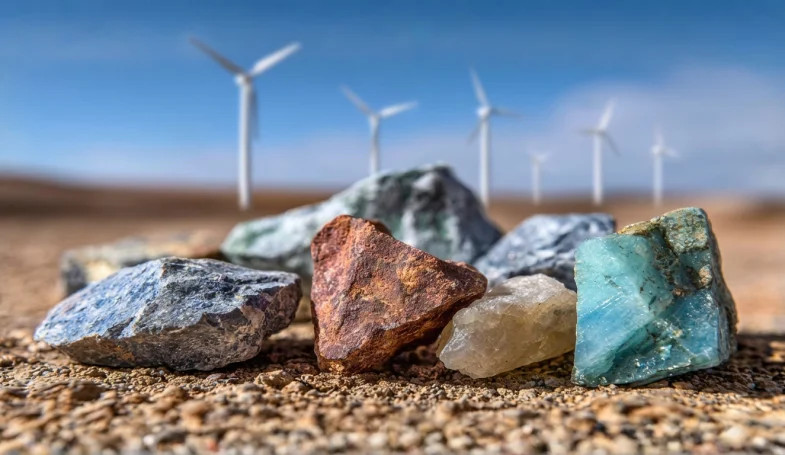
Brazil brings together territorial scale, geological diversity and relevant reserves of iron, gold, copper, manganese, nickel, graphite, lithium, niobium, tin, titanium and rare earths. This base gains importance at a time when renewable energy, electric mobility, digital infrastructure and industrial security are increasing the demand for critical and strategic minerals.
The potential, however, is not just in the existence of the ore. Opportunity arises when research, licensing, infrastructure, capital and execution capacity combine to form an economically viable operation.
Geological potential is not a reserve
An occurrence, a positive sample or an isolated report do not prove an economically exploitable deposit. The investor needs to know the continuity of mineralization, the estimated volume, the average grade, the metallurgical recovery, the mining method and the extraction and processing costs.
The content should also not be analyzed alone. A lower grade deposit may be more attractive when it has efficient scale, logistics and recovery; A high-grade ore may lose value in the face of small volume or strong operational restrictions.
Mining law and legal security
In Brazil, mineral resources belong to the Union. Land ownership does not automatically grant the right to explore the subsoil. Therefore, due diligence must verify the holder of the process, the authorized substance, the area, the phase before the National Mining Agency, the pending requirements, the deadlines and the possibility of assignment or transfer.
Without mining regularity and clarity of ownership, there is no secure basis for investment, partnership or acquisition.
Infrastructure, environment and social license
Competitiveness depends on access to energy, water, roads, railways, ports, labor and processing units. For large-volume ores with lower value per ton, logistics can define economic viability.
Environmental licensing also influences deadlines, investment, financing and future value. In addition to formal licenses, projects need to build legitimacy with communities, workers, owners and local governments.
Due diligence and asset preparation
A consistent assessment integrates geological, mining, environmental, operational, logistical, financial, legal and corporate analyses. Projects presented only by photographs, samples or promises of large reserves carry high risk.
To attract qualified capital, the asset must present location, maps, mining situation, geological studies, laboratory analysis, infrastructure, environmental condition, investment needs, projections, risks and verifiable documentation.
Governance transforms potential into value
Brazil has the conditions to occupy a relevant position in the new mineral economy. But the best opportunities won't necessarily be the ones that make the biggest promises. They will be those capable of demonstrating geological quality, regularity, viability, competitiveness and execution.
In the mineral market, potential opens doors. Governance, proof and ability to operate transform this potential into value.
Unparalleled Business
Knowledge. Governance. Opportunity.
Strategic Assets Series